
What horizontal and vertical SaaS actually mean
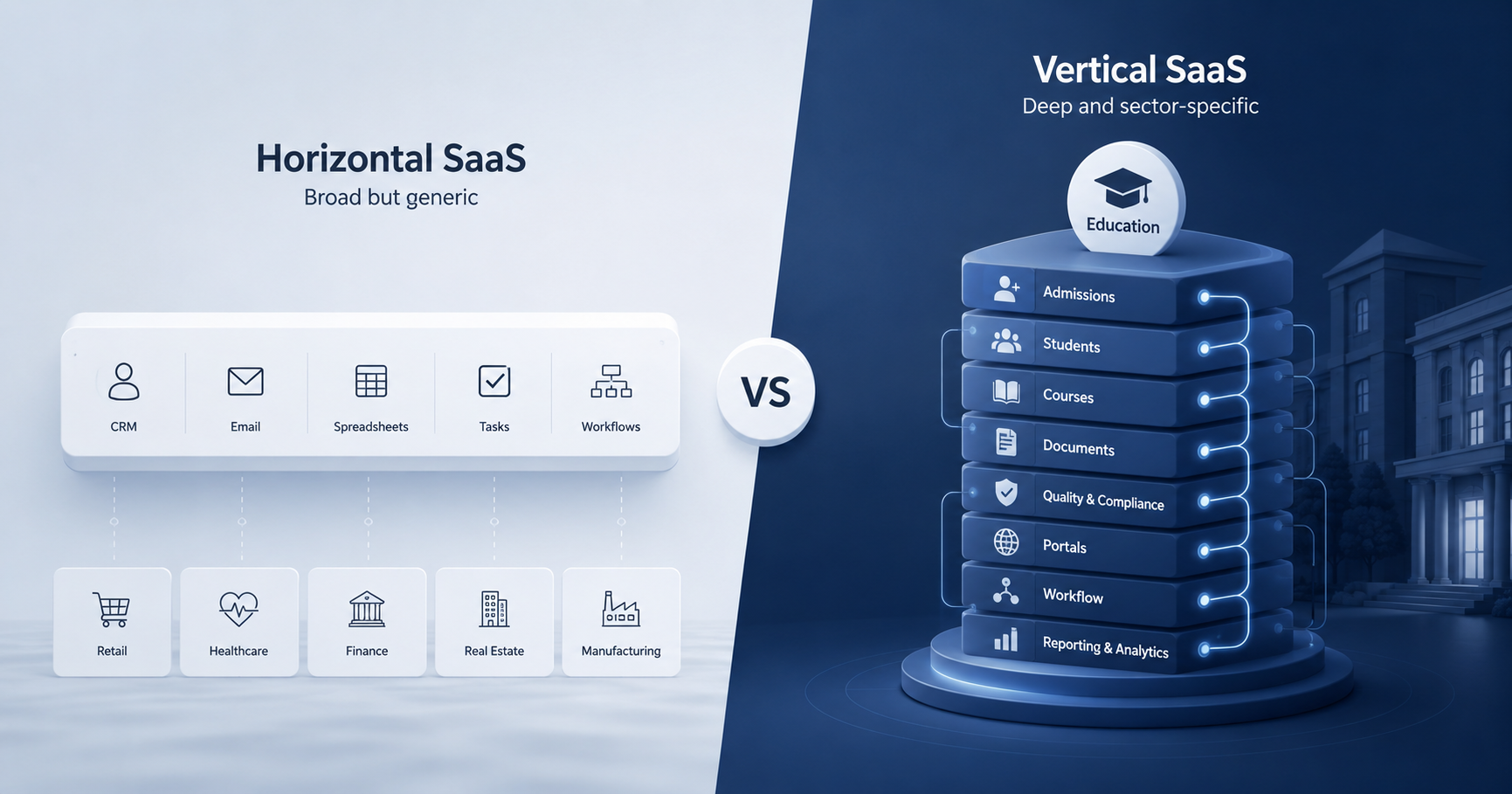
Horizontal SaaS targets a job that exists across every industry — email, spreadsheets, generic CRM, generic project management, generic HR. The product is intentionally broad so the same tool can serve a law firm, a manufacturer and a training centre with the same core building blocks.
Vertical SaaS is designed around one sector. The data model, terminology, workflows, roles, portals and reporting reflect how that industry actually operates. Education platforms model students, cohorts, admissions and quality processes; healthcare platforms model patients, encounters and clinical protocols; field-service platforms model jobs, technicians and assets.
Horizontal SaaS is often enough
Not every organisation needs a sector-specific system. Horizontal SaaS is usually the right answer when:
- · Workflows are simple and mostly linear.
- · Sector-specific requirements are low or informal.
- · You have strong internal integration and configuration capability.
- · Low per-seat cost matters more than short time to value.
- · A large ecosystem of third-party add-ons is important.
In those cases, a generic CRM, a spreadsheet suite and a project tool can carry an organisation a long way.
Signals your operations have outgrown a generic stack
As soon as operations become sector-specific, generic tools start to strain. Common patterns we see:
- · Renamed fields and generic objects pretending to be students, learners, patients, jobs or cases.
- · Disconnected tools for CRM, documents, tasks, portals and reporting, each with its own login and permission model.
- · Duplicated records across systems, kept in sync by hand.
- · Manual evidence collection for quality, accreditation or audits, usually spread across email inboxes and shared drives.
- · Weak workflow traceability — it is hard to answer who did what, when, and on which record.
- · Compliance and quality processes managed outside the system, in checklists and side-documents rather than the operational tool itself.
These are not tooling bugs. They are the natural limit of a horizontal product asked to do a sector-specific job.
Horizontal vs vertical SaaS at a glance
| Dimension | Horizontal SaaS | Vertical SaaS |
|---|---|---|
| Audience | Any industry | One sector |
| Data model | Generic entities | Sector-native entities |
| Workflows | Configurable from scratch | Sector workflows out of the box |
| Terminology | Business-generic | Industry-native |
| Compliance & quality support | Left to the customer to assemble | Sector-specific controls, records and evidence workflows |
| Portals | Generic or bolted on | Role-based portals aligned with sector stakeholders |
| Reporting | Generic dashboards, custom-built | Sector KPIs and operational reports included |
| Auditability & evidence management | Manual, tool-by-tool | Native to the operational workflow |
| Onboarding / time to value | Long — heavy setup and glue work | Shorter — sector defaults reduce configuration |
| Total cost of ownership | Lower per seat, higher in integration and manual effort | Higher per seat, lower in glue, duplication and workarounds |
Where each approach wins
Horizontal SaaS wins when
- · The process really is the same across industries.
- · You have engineers to configure, integrate and maintain.
- · A large ecosystem of third-party add-ons matters.
- · Per-seat cost is more important than time to value.
Vertical SaaS wins when
- · Your operations have sector-specific rules and records.
- · Teams need one connected system, not five glued tools.
- · Quality, audit and evidence are part of daily work.
- · You want a shorter path from purchase to real use.
A practical checklist before you buy
Run these questions against your current stack. If you answer "yes" to more than two, a vertical platform is likely to pay back faster than another horizontal tool.
- Are you renaming generic CRM objects just to make them fit your sector?
- Are critical records stored across spreadsheets, email inboxes and disconnected tools?
- Do you need auditable evidence for quality, accreditation or internal governance?
- Can your team manage the full lifecycle of a student, learner, client, job or case in one system?
- Does the platform support your sector workflows before expensive configuration starts?
- Can portals, documents, permissions and reports follow the same operating model?
A modular ecosystem for connected operations
GestWave is a modular vertical SaaS ecosystem built by ARP Group Ltd in Malta. It is not a single generic CRM. Instead, GestWave is a family of sector-specific products that share a common operational core — CRM, workflows, documents, portals, permissions, audit and reporting — so teams work in one connected environment rather than a patchwork of disconnected tools.
This shared core is designed to help organisations manage records, roles and processes consistently across products, while each product keeps the depth of its own sector.
GestWave Edupro focuses on the operational side of education management: admissions, student records, course administration, documents and quality workflows. GestWave VLE supports online and blended learning delivery. They are distinct products with distinct roles, designed to work together as connected parts of a broader GestWave ecosystem. Learn more about the shared operational core or explore the full product ecosystem.
Map your operations with GestWave
Tell us how your admissions, documents, courses, learners, quality processes and reporting work today. We will help you understand whether a vertical GestWave product, or a connected product combination, fits your organisation.
Map your operations with GestWave